1. Course Name
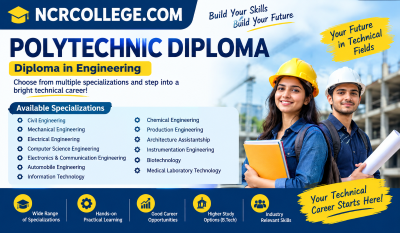
Polytechnic Diploma
Polytechnic courses are diploma-level technical programmes designed to provide students with practical knowledge and technical skills in different engineering and technology fields.
Popular Polytechnic Branches
- Mechanical Engineering
- Electrical Engineering
- Computer Science Engineering
- Electronics & Communication Engineering
- Automobile Engineering
- Information Technology
- Chemical Engineering
- Production Engineering
- Architecture Assistantship
- Instrumentation Engineering
- Biotechnology
- Medical Laboratory Technology
2. Course Duration
- Most Engineering Polytechnic Diploma courses: 3 years
- Some programmes may have different durations depending on the branch and institution.
- Eligible students may also enter the second year through lateral entry, subject to the rules of the concerned institution or state authority. AICTE's current handbook provides 3–4 years for diploma programmes and allows specified lateral-entry routes.
3. Eligibility
For most Engineering and Technology Diploma programmes:
- Passed Class 10 / SSC or equivalent from a recognised board.
- Science and Mathematics are commonly required for engineering branches.
- Eligibility and minimum marks can vary according to the branch, state and institute.
- Students with 10+2 or ITI qualifications may be eligible for lateral entry in some programmes, subject to applicable rules.
4. Approximate Fee
Approx. ₹25,000 – ₹1,00,000 per year for many private Polytechnic institutions.
Government and university Polytechnic fees can be considerably lower, while private/self-financed programmes may cost more. Fees also vary by branch, institution, state and other charges, so students should confirm the current fee before admission.
5. Admission Process
Admission may be through:
- State-level Polytechnic entrance examination
- Merit-based admission
- Direct admission, where permitted
- Counselling and seat allocation
- Document verification and fee submission
The process differs from state to state. For example, Uttar Pradesh conducts UPJEE (Polytechnic)/JEECUP for admission to government and private Polytechnic institutions in the state.
6. Mode of Study
- Regular classroom-based study
- Practical laboratory training
- Workshop and project work
- Industrial training/internship where applicable
The exact mode depends on the institution and programme.
7. Main Subjects / Syllabus
Subjects depend on the selected branch.
Common Subjects
- Engineering Mathematics
- Applied Physics
- Applied Chemistry
- Engineering Drawing
- Workshop Practice
- Computer Fundamentals
- Communication Skills
- Practical Laboratory Work
Branch-Specific Subjects
Mechanical: Manufacturing, Machine Design, Thermodynamics, Automobile basics
Electrical: Electrical Machines, Electrical Measurements, Power Systems, Wiring and Installation
Computer Science / IT: Programming, Computer Networks, Database Management, Web Technology
Electronics & Communication: Electronic Devices, Digital Electronics, Communication Systems, Microprocessors
Civil: Surveying, Construction Technology, Building Materials, Structural Engineering
Automobile: Automobile Engineering, Vehicle Systems, Engine Technology, Vehicle Maintenance
Syllabus varies by branch and affiliating technical board/institution.
8. Career Scope
A Polytechnic Diploma can provide a pathway to:
- Technical jobs in private companies
- Manufacturing and production industries
- Construction and infrastructure
- Electrical and power sectors
- Automobile industries
- IT and computer-related technical roles
- Electronics and communication industries
- Government technical positions, where the recruitment rules permit
- Apprenticeship and industrial training
Diploma holders can also continue their education through B.Tech/B.E. lateral entry, subject to the eligibility rules of the university or state.
9. Job Opportunities
Depending on the branch, students may find opportunities in:
- Manufacturing companies
- Construction companies
- Automobile companies
- Electrical and power companies
- IT and technology companies
- Electronics industries
- Infrastructure projects
- Production units
- Maintenance departments
- Government departments
- Public-sector organisations
- Apprenticeship programmes
AICTE's National Apprenticeship Training Scheme also provides apprenticeship opportunities for eligible diploma holders, generally for 6 months to 1 year.
10. Common Job Roles
Possible job roles include:
- Junior Engineer
- Technician
- Technical Assistant
- Site Supervisor
- Maintenance Technician
- Production Supervisor
- CAD/Draughtsman
- Electrical Technician
- Computer Technician
- IT Support Technician
- Quality Control Technician
- Automobile Technician
- Laboratory Technician
- Field Technician
Actual job titles and eligibility depend on the branch and employer.
11. Expected Salary Range
Salary varies significantly according to branch, location, employer, skills and experience.
As a broad 2026 indication:
- Freshers: around ₹15,000–₹30,000 per month in many private-sector roles
- Experienced diploma holders: around ₹25,000–₹50,000+ per month in some roles
- Government technical positions follow the applicable government pay scale and recruitment rules.
For example, salary data for Diploma Civil Engineers shows a wide range depending on experience and employer, demonstrating why one fixed salary figure should not be assumed.
12. Higher Study Options
After completing a Polytechnic Diploma, students can consider:
- B.Tech / B.E. through lateral entry
- Advanced diploma or specialised technical certifications
- Skill-based certification courses
- Industry training and apprenticeships
- Government technical recruitment examinations
Some institutions admit eligible diploma holders directly into the second year of B.Tech/B.E., subject to their admission rules.
13. Universities / Institutions Offering Polytechnic
Polytechnic programmes are offered by government polytechnics, university polytechnics, state technical institutions and private colleges.
One example is Jamia Millia Islamia (JMI) University Polytechnic, which offers 3-year Diploma Engineering programmes in:
- Civil Engineering
- Computer Engineering
- Electrical Engineering
- Electronics Engineering
- Mechanical Engineering
Other Polytechnic institutions are available across different states, with courses and admission rules varying by institution.
14. University/Institution-wise Eligibility & Approximate Fees
| Institution / Route | Duration | Eligibility | Fee Information |
|---|---|---|---|
| Jamia Millia Islamia – University Polytechnic | 3 years | Class 10/SSC with required Science & Mathematics criteria | Current fee should be checked in the latest JMI prospectus |
| Government Polytechnics | Usually 3 years | Generally Class 10; branch-specific requirements apply | Usually lower than private institutions; varies by state |
| Private Polytechnics | Usually 3 years | Generally Class 10; institute-specific criteria apply | Approx. ₹25,000–₹1,00,000+ per year |
| State Technical Board Affiliated Institutes | Usually 3 years | As prescribed by the concerned state/board | Varies by state and institution |
For JMI specifically, its official programme page confirms a 3-year Diploma Engineering programme, while the current fee is directed to the applicable prospectus rather than giving one fixed amount on the course page.
Need Degree Guidance?
Our authorized counselors can verify your eligibility and find the optimal university program.