JBT – Junior Basic Training Course
Welcome to JBT Course
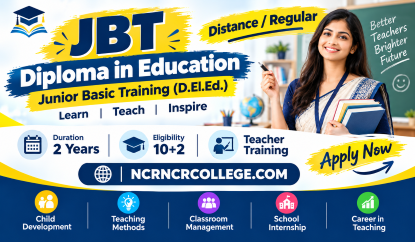
JBT (Junior Basic Training) is a teacher-training programme designed for students who want to build a career in primary and elementary education. JBT is commonly associated with D.El.Ed. (Diploma in Elementary Education) in different states. The programme focuses on child development, teaching methods, classroom management and practical teaching experience.
1. Course Name
- JBT – Junior Basic Training
- Commonly related to D.El.Ed. – Diploma in Elementary Education
- It is a professional teacher-education diploma.
2. Course Duration
- 2 Years
- The NCTE framework specifies D.El.Ed. as a two-year professional teacher-education programme.
- The programme generally includes classroom study as well as practical school experience.
3. Eligibility
Generally, students should have:
- Passed Class 12th / Senior Secondary or equivalent from a recognized board.
- Many institutions require around 50% marks in Class 12th.
- Eligibility, reservation and relaxation rules can vary by state and institution.
For example, the SCERT Delhi 2026 D.El.Ed. prospectus requires 10+2 or equivalent with 50% aggregate marks.
4. Approximate Fee
Fees vary according to the state, institute and category.
Delhi – 2026 Reference
Government DIETs:
- Admission Fee: ₹5
- Caution Money: ₹100
- Pupil Fund: ₹150 per month
- Maintenance & Upgradation Fund: ₹50 per month
- Development Fund: ₹500 per month
- Examination Fee: ₹2,500 per year
The listed government-fee components work out to approximately ₹11,005 per year, excluding any other applicable charges.
SCERT Delhi recognized private institutes:
- Maximum course fee: ₹37,500 per year
- Examination fee: ₹2,500 per year
- Total: approximately ₹40,000 per year maximum under the 2026 SCERT Delhi prospectus.
Note: Fees outside Delhi may be different.
5. Admission Process
The admission process depends on the state and institution.
Generally, students need to:
- Check eligibility.
- Complete the application form.
- Submit required documents.
- Appear for an entrance examination if required.
- Check merit/rank or counselling results.
- Complete document verification.
- Pay the admission/course fee.
- Join the allotted institute.
For SCERT Delhi D.El.Ed. 2026, admission is based on a Computer-Based Entrance Test (CBT) followed by rank/merit-based seat allocation and counselling.
6. Mode of Study
- Generally full-time classroom-based teacher education.
- Includes theory, practical activities, assignments and school experience.
- Exact mode depends on the recognized institution and state rules.
SCERT Delhi's 2026 programme includes classroom learning and a School Experience Programme (SEP).
7. Main Subjects / Syllabus
The syllabus generally covers:
First Year
- Child Development
- Education and Society
- Educational Technology
- Hindi / Regional Language Education
- English Language Education
- Mathematics Education
- Environmental Studies Education
- Health and Physical Education
- Work Education
- Art Education
- School Experience Programme
Second Year
- Psychological Perspectives of Education
- Socio-Philosophical Perspectives of Education
- Curriculum, Pedagogy and Evaluation
- School Leadership and Management
- Language Education
- English Education
- Mathematics Education
- Social Studies Education
- Science Education
- Health and Physical Education
- Work Education
- Arts in Education
- School Experience Programme
These subjects are based on the SCERT Delhi 2026 D.El.Ed. curriculum; exact subjects may vary by state/institute.
8. Career Scope
JBT/D.El.Ed. can provide a foundation for a career in:
- Primary Education
- Elementary Education
- Private Schools
- Government School Teacher Recruitment
- Teaching Support Roles
- Educational Institutions
- School-Based Learning Programmes
For government teaching posts, additional qualifications such as CTET or State TET may be required depending on the recruitment rules.
9. Job Opportunities
After completing the required qualification and recruitment requirements, students may explore:
- Primary Teacher
- Elementary School Teacher
- Assistant Teacher
- Private School Teacher
- Contract Teacher
- Teaching Assistant
- Education Support Staff
Government jobs are subject to the qualification, TET/CTET, recruitment examination and other requirements of the concerned authority.
10. Common Job Roles
- PRT – Primary Teacher
- Elementary Teacher
- Assistant Teacher
- Junior Teacher
- Private School Teacher
- Contract Teacher
- Teaching Assistant
11. Expected Salary Range
Salary depends on the school, location, experience and whether the position is government or private.
As a broad reference:
- Private schools: approximately ₹10,000–₹30,000+ per month depending on the institution and experience.
- Contract teaching: can vary significantly by school/authority. For example, a 2026 KVS-related recruitment document lists ₹21,250 per month for PRT Balvatika teachers on a consolidated basis.
- Government PRT positions: salary follows the applicable government pay scale and recruitment rules.
Therefore, salary should not be treated as a fixed amount.
12. Higher Study Options
After JBT/D.El.Ed., students can consider:
- B.A.
- B.Ed. where eligible
- B.El.Ed. / other teacher-education programmes, subject to eligibility
- Graduation followed by further professional qualifications
- CTET / State TET preparation
- Other education-related higher studies
13. Universities / Institutions Offering JBT / D.El.Ed.
JBT is not offered under one single national university system. The programme is offered through state teacher-education authorities, DIETs and recognized teacher-training institutes.
Delhi Example – SCERT Delhi
SCERT Delhi's 2026 D.El.Ed. admission system lists:
Government DIETs, including:
- DIET Keshav Puram
- DIET Pitampura
- DIET Rajinder Nagar
- DIET Darya Ganj
- DIET R.K. Puram
- DIET Bhola Nath Nagar
- DIET Karkardooma
- DIET Moti Bagh
- DIET Ghuman Hera
SCERT Delhi lists 9 Government DIETs with 1,040 seats for the 2026 programme.
SCERT Delhi also lists recognized self-financing private D.El.Ed. institutes for the 2026 session.
Important: Students should verify the institute's current recognition/affiliation before admission. NCTE maintains recognized-institution records for teacher-education programmes.
14. Institute-wise Eligibility and Approximate Fees
| Institute Type | Eligibility | Approx. Fee |
|---|---|---|
| Government DIET – Delhi | 10+2 with 50% aggregate for SCERT Delhi 2026 | About ₹11,005/year based on listed fee components |
| SCERT Delhi Recognized Private Institute | 10+2 with 50% aggregate for SCERT Delhi 2026 | Up to ₹37,500/year + ₹2,500 exam fee |
| Other State/Private Institutes | Usually 10+2; marks and rules vary | Varies by state/institute |
SCERT Delhi's 2026 prospectus specifies the above eligibility and fee structure.
15. Entrance Exam / Other Requirements
Entrance requirements depend on the state.
SCERT Delhi – 2026
- Computer-Based Entrance Test
- 150 questions
- 150 marks
- Duration: 2 hours
- Hindi and English medium
- No negative marking
- Admission based on entrance-test rank/merit and eligibility.
The 2026 entrance syllabus includes:
- General Awareness
- Social Science
- General Science
- Basic Computers
- Mathematics
- General Mental Ability
- Teaching/Education-related aptitude
- English and Hindi
Why Choose JBT?
JBT is suitable for students who:
- Enjoy working with children.
- Want to enter the teaching field.
- Are interested in primary and elementary education.
- Want practical classroom experience.
- Wish to prepare for future teacher eligibility and recruitment pathways.
Need Degree Guidance?
Our authorized counselors can verify your eligibility and find the optimal university program.