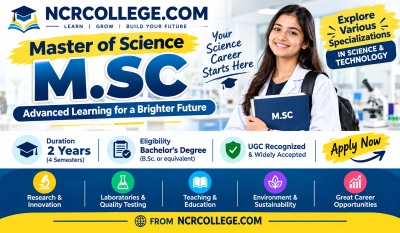
Welcome to Vale! M.Sc. (Master of Science) is a postgraduate degree designed for students who want to gain advanced knowledge in science and develop skills for research, teaching, laboratories, technology and industry.
M.Sc. is available in many specializations, so the eligibility, subjects, fees and admission requirements can vary by university and specialization.
1. Course Name
Master of Science (M.Sc.)
Popular specializations include:
M.Sc. Physics
M.Sc. Chemistry
M.Sc. Mathematics
M.Sc. Zoology
M.Sc. Botany
M.Sc. Biotechnology
M.Sc. Microbiology
M.Sc. Computer Science
M.Sc. Environmental Science
M.Sc. Data Science
M.Sc. Life Sciences
M.Sc. Food Science and Nutrition
2. Course Duration
Usually 2 years
Generally divided into 4 semesters
Some universities may have different structures depending on the programme.
For example, IGNOU lists several M.Sc. programmes with a minimum duration of 24 months and a maximum duration of 48 months.
3. Eligibility
Generally, candidates need:
A Bachelor's degree from a recognized university.
Usually a B.Sc. or relevant undergraduate degree is required.
The required subjects at graduation level depend on the chosen M.Sc. specialization.
Minimum marks may vary by university and programme.
For example, Delhi University publishes separate eligibility requirements for individual M.Sc. programmes.
Important: Students should check the exact eligibility requirements for their selected specialization before applying.
4. Approximate Fee
M.Sc. fees vary significantly according to the university, specialization and mode of study.
A broad indicative range is:
Government/Public Universities: approximately ₹10,000–₹60,000+ per year
Private Universities: approximately ₹50,000–₹2,00,000+ per year
Open/Distance programmes: fees can be lower and vary by specialization.
For example, IGNOU currently lists different fees for different M.Sc. programmes. Its M.Sc. Analytical Chemistry is listed at ₹46,600 for the full programme, while M.Sc. Information Security is listed at ₹22,000 per year.
Note: Exact fees should always be checked with the university for the current admission session.
5. Admission Process
The admission process may include:
Check eligibility for the selected M.Sc. specialization.
Complete the university application form.
Appear for an entrance examination if required.
Check the merit list/entrance result.
Complete counselling or seat allocation where applicable.
Submit the required documents.
Pay the admission fee and confirm the seat.
For example, Delhi University states that admission to its two-year PG programmes for 2026-27 is based on CUET(PG)-2026, followed by the university's CSAS(PG) process.
6. Mode of Study
Depending on the university and programme, M.Sc. may be available through:
Regular / Campus study
Distance / Open Learning
Online learning for selected programmes
Students should confirm whether their chosen specialization is available in their preferred mode.
7. Main Subjects / Syllabus
The syllabus depends on the specialization.
Common areas may include:
Advanced concepts related to the selected science subject
Practical and laboratory work
Research methods
Data analysis
Scientific writing
Project work
Seminars and presentations
Dissertation/project in some programmes
For example, an M.Sc. Chemistry programme may include Organic, Inorganic and Analytical Chemistry, while M.Sc. Biotechnology may include Genetics, Molecular Biology, Biochemistry and Biotechnology-related subjects.
8. Career Scope
After completing an M.Sc., students can explore opportunities in:
Research and Development
Laboratories
Pharmaceutical companies
Biotechnology companies
Healthcare and diagnostic laboratories
Environmental organisations
IT and data-related industries
Educational institutions
Government departments
Scientific organisations
Quality control and testing
Academic research
Career options depend strongly on the M.Sc. specialization, practical skills, experience and further qualifications.
9. Job Opportunities
M.Sc. graduates may find opportunities as:
Research Associate
Research Assistant
Laboratory Executive
Scientific Assistant
Quality Control Executive
Data Analyst
Subject Matter Expert
Project Assistant
Technical Assistant
Lecturer/Teacher, subject to required qualifications
Scientific or Technical Officer
10. Common Job Roles
Some common roles include:
Research Associate
Research Assistant
Laboratory Analyst
Quality Control Analyst
Scientific Assistant
Research Scientist
Data Analyst
Project Assistant
Technical Executive
Teacher / Lecturer, where applicable
11. Expected Salary Range
Salary depends on specialization, job role, location, employer, experience and additional qualifications.
As an indicative reference, reported salary data for Research Associates in India shows approximately ₹2 lakh–₹8 lakh per year, while reported Associate Research Scientist salaries range around ₹3.2 lakh–₹14 lakh per year across experience levels. These are job-market salary estimates, not guaranteed salaries for all M.Sc. graduates.
12. Higher Study Options
After M.Sc., students can consider:
Ph.D.
M.Phil. where applicable
PG Diploma / Advanced Certificate programmes
Professional certifications
Research fellowships
Competitive examinations
Teaching-related qualifications where required
Students interested in research and academic careers commonly consider a Ph.D. after M.Sc.
13. Universities Offering M.Sc.
Some universities/institutions offering M.Sc. programmes include:
University of Delhi (DU)
Indira Gandhi National Open University (IGNOU)
Banaras Hindu University (BHU)
Jamia Millia Islamia (JMI)
University of Mumbai
Other recognized central, state and private universities
The exact M.Sc. specializations offered differ from university to university. DU, for example, lists multiple M.Sc. programmes under its Faculty of Science and other departments.
14. University-wise Eligibility and Approximate Fees
University
M.Sc. Eligibility
Approximate Fee
University of Delhi
Varies by specialization; relevant Bachelor's degree/subjects required
Varies by programme
IGNOU
Varies by M.Sc. specialization; relevant graduation may be required
Relevant Bachelor's degree and programme-specific requirements
Varies by programme
Private Universities
Usually relevant Bachelor's degree; requirements vary
Generally higher than many public universities
Important: There is no single fee or eligibility rule for all M.Sc. programmes. Students should check the official prospectus of the selected university before admission.
IGNOU's official programme pages demonstrate this variation: its M.Sc. Biochemistry, M.Sc. Information Security and other M.Sc. programmes have different eligibility and fee structures.
Quick Summary
Course: M.Sc. – Master of Science Duration: Usually 2 Years Level: Postgraduate Eligibility: Relevant Bachelor's Degree, usually B.Sc. or equivalent Fees: Varies by university and specialization Admission: Merit-based or entrance-based, depending on university Career Areas: Research, Laboratories, Education, Pharma, Biotechnology, IT/Data, Environment and Industry Higher Studies: Ph.D. and other specialized programmes
DIRECT ENROLLMENT
Need Degree Guidance?
Our authorized counselors can verify your eligibility and find the optimal university program.