ITI Course –
1. Course Name
Industrial Training Institute (ITI)
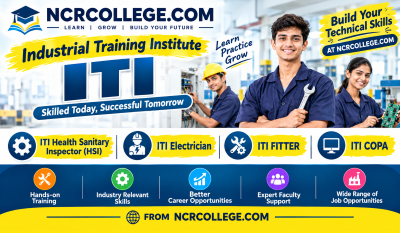
Popular ITI trades include:
- ITI Electrician
- ITI Fitter
- ITI Computer Operator and Programming Assistant (COPA)
- ITI Health Sanitary Inspector (HSI)
- Other technical and non-technical trades as offered by the institute.
2. Course Duration
Duration depends on the selected trade:
- Electrician: 2 Years
- Fitter: 2 Years
- COPA: 1 Year
- Health Sanitary Inspector: 1 Year
DGT trade information confirms these durations.
3. Eligibility
- Generally, candidates must have passed Class 10th for the above trades.
- Electrician and Fitter require 10th with Science and Mathematics or an accepted equivalent/vocational subject.
- COPA requires 10th pass.
- Health Sanitary Inspector requires 10th pass.
- Minimum age can vary according to the trade/admission authority; the DGT COPA curriculum specifies 14 years as the minimum age at the start of the academic session.
4. Approximate Fee
ITI fees vary by institute, state, trade and whether the institute is government or private.
- Government ITIs generally have lower course fees.
- Private ITI fees are usually higher and vary by institute.
- Additional charges may include examination, registration, tools, uniform or other institute charges.
Exact fees should be checked with the selected ITI before admission.
5. Admission Process
The usual admission process includes:
- Select an ITI trade.
- Check eligibility.
- Apply through the relevant State ITI admission portal or institute.
- Complete merit/selection or other applicable admission process.
- Submit required documents.
- Pay the applicable admission/course fee.
- Start ITI practical and classroom training.
Admission rules and schedules can differ by state.
6. Mode of Study
ITI is primarily practical and classroom-based vocational training.
Students generally receive:
- Practical workshop training
- Trade theory
- Employability skills
- Hands-on activities
- Industry exposure/apprenticeship opportunities where applicable
DGT also operates the Dual System of Training, which combines ITI training with industry exposure.
7. Main Subjects / Syllabus
Electrician
- Electrical fundamentals
- Wiring and electrical installation
- Electrical machines
- Measuring instruments
- Motors and transformers
- Electrical safety
- Practical workshop training
Fitter
- Workshop calculations
- Engineering drawing
- Fitting operations
- Tools and measuring instruments
- Metal work
- Machine-related practical work
- Safety practices
COPA
- Computer fundamentals
- Operating systems
- Word processing
- Spreadsheets
- Presentations
- Internet and email
- Basic programming
- Database/computer applications
- Practical computer training
DGT's current COPA curriculum specifies a one-year programme with 1,200 hours plus 150 hours of OJT/group project.
Health Sanitary Inspector
- Public health and sanitation
- Personal and environmental hygiene
- Waste management
- Water and food hygiene
- Health and safety practices
- Sanitation inspection
- Practical field-related training
The DGT curriculum describes HSI as a one-year CTS trade.
8. Career Scope
ITI provides job-oriented technical and vocational skills. After completing an ITI trade, students can explore:
- Private-sector employment
- Government-sector opportunities where eligible
- Apprenticeships
- Industrial jobs
- Technical support work
- Self-employment/business
- Further technical education
Students can also pursue apprenticeship training; DGT states that successful trade apprentices can receive the National Apprenticeship Certificate (NAC).
9. Job Opportunities
Depending on the trade, opportunities may be available in:
- Manufacturing industries
- Electrical companies
- Construction companies
- Automobile industries
- Power-related organisations
- Maintenance departments
- IT/computer service businesses
- Hospitals and healthcare-related organisations
- Municipal/local sanitation services
- Workshops and service centres
- Government and public-sector organisations, subject to recruitment rules
10. Common Job Roles
Electrician
- Electrician
- Electrical Technician
- Maintenance Technician
- Wiring Technician
Fitter
- Fitter
- Machine Maintenance Technician
- Production Technician
- Mechanical Technician
COPA
- Computer Operator
- Data Entry Operator
- Computer Assistant
- Office/IT Support Assistant
Health Sanitary Inspector
- Health Sanitary Inspector
- Sanitation Inspector
- Hygiene/Sanitation Worker
- Sanitary Supervisor
11. Expected Salary Range
Salary depends strongly on trade, location, employer, skills and experience.
As an example of current market data, AmbitionBox reports ITI Electrician salaries in India in a broad range of about ₹1 lakh–₹5.3 lakh per year across the experience range represented in its dataset; ITI Fitter salaries also vary substantially by employer and experience. These are market-reported figures, not guaranteed starting salaries.
For students, it is better to present salary as:
Starting Salary: Varies by employer and trade. Experienced professionals may earn significantly more.
12. Higher Study / Career Progression Options
After ITI, students can consider:
- Apprenticeship training
- National Apprenticeship Certificate (NAC)
- Advanced vocational programmes
- CITS for eligible candidates who want to become ITI instructors
- Relevant diploma/polytechnic programmes
- Trade-specific advanced training
- Skill-development programmes
- Employment followed by further technical education
DGT lists apprenticeship and further vocational progression routes for ITI trainees.
13. Institutes Offering ITI Courses
ITI courses are offered by Government ITIs and Private ITIs across India.
Because ITI is a vocational training programme rather than a university degree, it is more accurate to list ITIs/training institutes, not “universities offering this course.”
The exact availability of Electrician, Fitter, COPA, HSI and other trades depends on the individual ITI.
14. Institute-wise Eligibility and Approximate Fees
There is no single fee structure for all ITIs.
| Institute Type | Eligibility | Fee |
|---|---|---|
| Government ITI | Depends on selected trade; generally 8th/10th/12th as prescribed | Varies by state/trade |
| Private ITI | Depends on selected trade | Varies by institute/trade |
For the NCR College website, I recommend writing:
“Fees vary according to the institute, trade and state. Students should confirm the latest fee structure before admission.”
Why Choose ITI?
- Practical skill-based training
- Short-duration vocational courses
- Industry-focused learning
- Apprenticeship opportunities
- Employment opportunities in different sectors
- Scope for self-employment
- Options for further technical education
Choose the right ITI trade according to your education, interests and career goals.
Need Degree Guidance?
Our authorized counselors can verify your eligibility and find the optimal university program.