Diploma in Computer Applications (DCA)
Course Overview
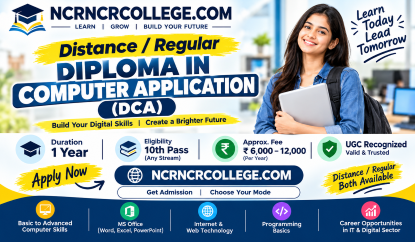
The Diploma in Computer Applications (DCA) is a short-term computer diploma that helps students develop practical knowledge of computers and commonly used software applications. The course generally covers computer fundamentals, office applications, databases, internet technologies, programming basics, web technologies, multimedia, and digital tools.
The exact syllabus, duration, eligibility, and fees may vary between universities and institutions.
1. Course Duration
- Generally 1 year
- Usually divided into 2 semesters
- Some institutes may offer shorter DCA programmes of around 6 months.
2. Eligibility
- Generally, candidates should have passed 10+2 (12th) or an equivalent examination from a recognized board.
- Eligibility may vary by university. For example, Guru Nanak Dev University requires 10+2 in any stream with at least 45% marks, while Makhanlal Chaturvedi National University accepts 10+2 in any discipline.
3. Approximate Fee
DCA fees vary considerably depending on the university, study mode, and facilities.
Indicative examples:
- Guru Nanak Dev University: ₹6,313 per semester.
- Parul University: ₹25,000 for the 1-year programme.
- Uttarakhand Open University: its current DCA fee structure varies by programme version and includes admission/examination components.
Note: Students should confirm the latest fee directly with the concerned university before admission.
4. Admission Process
The usual admission process is:
- Check eligibility requirements.
- Select the university or institution.
- Fill out the admission/application form.
- Upload or submit required documents.
- Pay the applicable admission/course fee.
- Complete verification, if required.
- Receive admission confirmation and begin the course.
Some universities offer admission based on merit, while others may have their own admission procedure.
5. Mode of Study
Depending on the institution, DCA may be available through:
- Regular/Classroom learning
- Open or Distance Learning
- Other institution-specific study arrangements
Students should check the approved mode offered by the specific university before admission.
6. Main Subjects / Syllabus
Common DCA subjects may include:
- Computer Fundamentals
- Operating Systems
- MS Word, Excel and PowerPoint
- Office Automation
- Internet and Web Technologies
- Database Management
- Programming Fundamentals
- C / Basic Programming
- MySQL or MS Access
- Multimedia
- Graphic Design / DTP
- E-Commerce
- Digital Applications
- AI and Modern IT Tools
- Practical Computer Training
The exact syllabus differs by university. For example, the 2026 DCA syllabus of Makhanlal Chaturvedi University includes Computer Fundamentals and AI Concepts, PC Packages and AI Office Tools, Database using MySQL/MS Access, Multimedia, Web Technologies and E-Commerce, and Digital Media/Graphic Design.
7. Career Scope
DCA provides a foundation in computer applications and can help students enter computer-based office and entry-level IT roles.
Career areas may include:
- IT Support
- Office Administration
- Data Management
- Data Entry
- Computer Operations
- Web and Digital Work
- Database Support
- Technical Support
- Business/Office Automation
- Basic Graphic and DTP Work
With additional skills and experience, students can move towards more specialized IT roles.
8. Job Opportunities
After completing DCA, students may apply for suitable entry-level positions such as:
- Computer Operator
- Data Entry Operator
- Office Assistant
- IT Support Assistant
- Technical Support Executive
- Junior Web Designer
- Computer Instructor — Basic Level
- Database Assistant
- DTP Operator
- Back Office Executive
- Computer Lab Assistant
Actual job eligibility depends on the employer and the candidate's skills and experience.
9. Common Job Roles
Popular job roles include:
- Computer Operator
- Data Entry Operator
- Office Assistant
- IT Support Executive
- Technical Support Assistant
- Junior Web Designer
- DTP Operator
- Computer Lab Assistant
- Back Office Executive
- Junior Programmer
10. Expected Salary Range
Salary depends on the job role, location, employer, practical skills, and experience.
As an indicative range, entry-level computer operator/data-entry positions may start around ₹15,000–₹25,000 per month, while skilled candidates and those moving into specialized roles may earn more with experience. Current salary sources show substantial variation by role and location; for example, PayScale reports an average computer-operator base salary of about ₹2.48 lakh per year in India in 2026.
Important: Salary is not guaranteed by the DCA qualification alone.
11. Higher Study Options
After DCA, students can consider further education such as:
- BCA – Bachelor of Computer Applications
- B.Sc. Computer Science / Information Technology
- Other computer and IT-related bachelor's programmes
- PGDCA after completing graduation
- Skill-based certifications in areas such as web development, digital marketing, databases, graphic design, or IT support
Eligibility for higher programmes depends on the university.
12. Universities / Institutions Offering DCA
Some institutions currently showing DCA programmes include:
| University / Institution | Duration | Eligibility | Approx. Fee |
|---|---|---|---|
| Guru Nanak Dev University (GNDU) | 1 Year | 10+2, 45% in any stream | ₹6,313/semester |
| Makhanlal Chaturvedi National University (MCU) | 1 Year | 10+2 in any discipline | University-specific |
| Parul University | 1 Year | 10+2 or equivalent | ₹25,000 |
| Uttarakhand Open University (UOU) | 1–2 Years depending on programme structure | 10+2* | Varies by programme |
| Shri Krishna University | 2 Semesters | 10+2 in any subject | ₹20,000 |
*UOU has different DCA programme structures, including a DCA version connected with an MCA bridge route, so students should check the specific programme eligibility before admission.
13. Entrance Exam / Other Requirements
- Generally, no national-level entrance examination is required for DCA.
- Admission is commonly based on the candidate's qualifying examination and the university's admission rules.
- Some universities may conduct their own selection/admission process.
- Students normally need documents such as:
- 10th Mark Sheet/Certificate
- 12th Mark Sheet/Certificate
- ID Proof
- Passport-size Photographs
- Migration/Transfer Certificate, if required
- Other documents specified by the institution
Why Choose DCA?
- Short-duration computer diploma
- Builds practical computer skills
- Useful for office and entry-level IT work
- Covers commonly used computer applications
- Suitable for students from different academic backgrounds
- Can be followed by higher education such as BCA or other IT programmes
Need Degree Guidance?
Our authorized counselors can verify your eligibility and find the optimal university program.